
Boost Conversions and Simplify Workflows with WhatsApp Automation
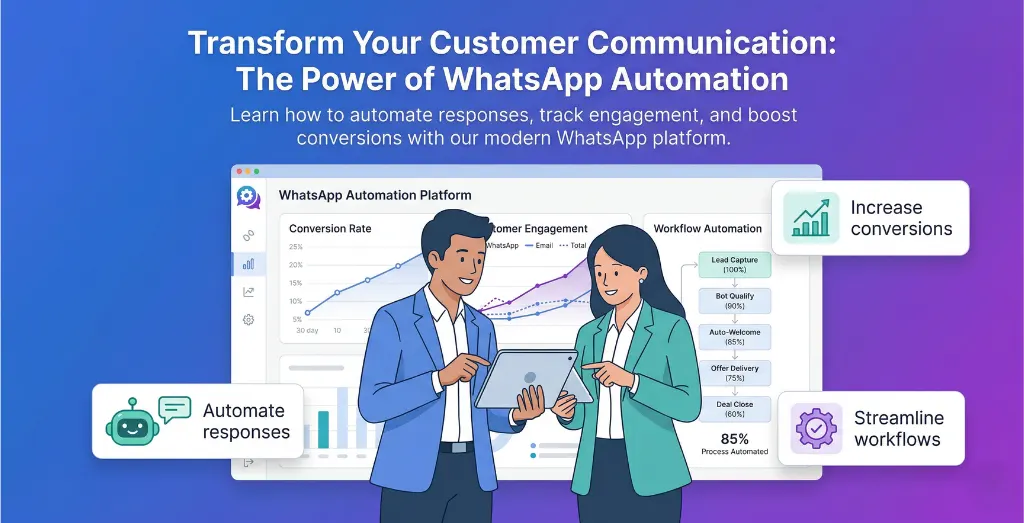
In today’s digital-first world, businesses are under constant pressure to respond faster, engage better, and convert more customers without increasing operational complexity. While marketing channels continue to evolve, customer expectations have shifted even faster. People no longer want to wait for responses, fill out long forms, or switch between multiple platforms to interact with a business.
Instead, they expect instant communication, seamless experiences, and personalized interactions — all within the tools they already use daily.
This is where WhatsApp automation is becoming a game changer for modern businesses.
By combining real-time messaging with intelligent automation, businesses can not only improve customer engagement but also streamline internal workflows and significantly increase conversions. Platforms like WhatsApp are no longer just communication tools; they have evolved into powerful business ecosystems.
The Shift Toward Conversational Business
Traditional business communication has long relied on emails, calls, and standalone applications. While these methods are still relevant, they often lack speed and convenience. Emails go unread, calls are missed, and mobile apps struggle with low adoption rates.
On the other hand, messaging platforms have become deeply integrated into everyday life. Customers are already comfortable using WhatsApp for personal communication, which makes it a natural extension for business interactions as well.
This shift toward conversational communication means that businesses no longer need to pull customers into new systems. Instead, they can meet them where they already are — inside a familiar and highly active platform.
Understanding WhatsApp Automation
WhatsApp automation refers to the use of software and predefined workflows to handle customer communication automatically. Rather than relying on manual responses, businesses can create systems that respond instantly, guide users through processes, and deliver relevant information at the right time.
This can include welcome messages, lead qualification flows, order confirmations, reminders, promotional campaigns, and customer support interactions.
The goal is not to replace human interaction, but to enhance it by handling repetitive tasks efficiently. This allows businesses to maintain consistency, reduce delays, and provide a better overall experience.
Why Automation is Critical for Conversions
One of the biggest reasons businesses lose potential customers is delayed response time. When a user shows interest—whether by sending a message, visiting a website, or adding a product to their cart—timing becomes critical.
If the response is slow or inconsistent, the customer is likely to lose interest or move to a competitor.
Automation ensures that every interaction is immediate. When a customer reaches out, they receive a response instantly. When they abandon a cart, they receive a reminder. When they make a purchase, they get confirmation and updates without delay.
This kind of responsiveness builds trust and keeps the customer engaged throughout their journey.
Simplifying Workflows Through Automation
Beyond improving customer experience, WhatsApp automation also plays a crucial role in simplifying internal workflows. Many businesses struggle with managing repetitive tasks such as answering common questions, sending updates, or following up with leads.
When these tasks are handled manually, they consume time, increase the risk of errors, and limit scalability.
With automation, these processes can be streamlined. A single system can handle multiple interactions simultaneously, ensuring consistency and efficiency. Teams can then focus on higher-value tasks such as closing deals, solving complex queries, or building relationships.
This shift not only improves productivity but also reduces operational costs over time.
Creating Seamless Customer Journeys
A major advantage of WhatsApp automation is the ability to design structured customer journeys. Instead of random or disconnected interactions, businesses can guide users step by step through a clear path.
For example, a potential customer can be welcomed with an automated message, introduced to available services, guided toward a specific product, and encouraged to take action — all within a single conversation.
This reduces friction and makes decision-making easier for the customer.
Similarly, after a purchase, businesses can continue the journey by sending updates, requesting feedback, and offering repeat purchase incentives. This continuous engagement plays a key role in building long-term customer relationships.
Enhancing Marketing with Real-Time Communication
Marketing is no longer just about reaching customers; it is about engaging them effectively. WhatsApp automation enables businesses to deliver highly targeted and timely messages that feel personal rather than intrusive.
Instead of generic mass communication, businesses can segment their audience and send relevant offers, updates, or recommendations based on user behavior.
Because these messages are delivered through a platform with high open and response rates, they are far more effective than traditional channels.
This allows businesses to optimize campaigns in real time and improve overall return on investment.
Improving Customer Support Efficiency
Customer support is another area where automation creates a significant impact. Many customer queries are repetitive and can be resolved instantly with predefined responses.
By automating these interactions, businesses can provide immediate assistance without overloading their support teams.
At the same time, more complex issues can be seamlessly transferred to human agents, ensuring that customers receive the right level of support when needed.
This balance between automation and human interaction creates a more efficient and satisfying support experience.
How Zepofy Enables Business Growth
Zepofy is built to help businesses unlock the full potential of WhatsApp automation by combining simplicity with powerful features. It allows businesses to automate communication, create structured workflows, and manage customer interactions from a single platform.
With Zepofy, businesses can design automated flows for lead generation, sales, and support without requiring technical expertise. The platform enables real-time engagement while reducing manual effort, making it easier for teams to scale their operations.
Whether it is sending automated messages, managing campaigns, or handling customer queries, Zepofy provides the tools needed to create a seamless and efficient communication system.
Real-World Applications Across Industries
The impact of WhatsApp automation is not limited to a single industry. E-commerce businesses use it to recover abandoned carts and send order updates. Service-based businesses rely on it for appointment scheduling and reminders. Educational institutions use it for student engagement, while local businesses leverage it to maintain relationships with their customers.
In each case, the core objective remains the same — to simplify communication while improving engagement and conversions.
The Future of Customer Engagement
As technology continues to evolve, the way businesses interact with customers will continue to shift toward more conversational and automated experiences.
Customers will increasingly expect instant responses, personalized communication, and frictionless journeys. Businesses that adopt these approaches early will have a clear competitive advantage.
WhatsApp automation represents a significant step in this direction, enabling businesses to align with modern expectations while improving efficiency.
Conclusion
Boosting conversions and simplifying workflows are two of the most important goals for any growing business. WhatsApp automation provides a practical and effective way to achieve both.
By enabling instant communication, structured customer journeys, and efficient internal processes, it helps businesses deliver better experiences while reducing operational complexity.
Zepofy brings these capabilities together into a unified platform, allowing businesses to transform the way they communicate, engage, and grow.
As customer expectations continue to rise, adopting solutions like WhatsApp automation is no longer optional — it is essential for staying competitive in today’s market.