
Best WhatsApp Marketing Tool for Your Business in India
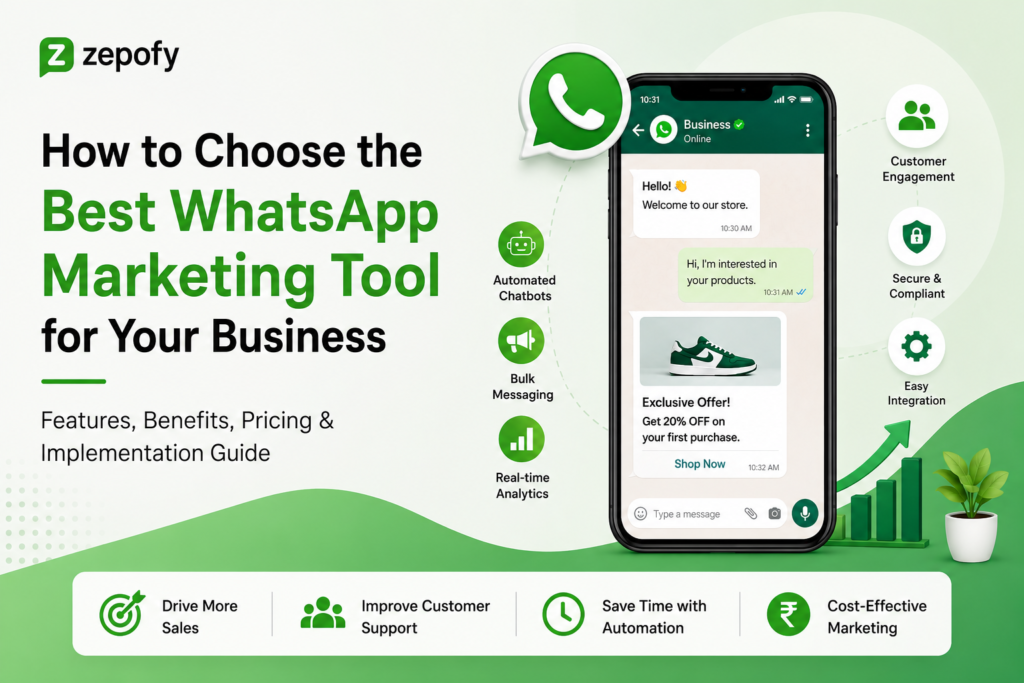
WhatsApp has become one of the most effective communication channels for businesses that want to connect with customers, generate leads, promote products, and provide faster customer support. From small businesses to growing companies, WhatsApp helps brands communicate with customers through a platform they already use every day.
However, managing customer conversations manually can become difficult as your business grows. Sending campaigns, responding to customers, following up with leads, and managing multiple conversations can take a significant amount of time. This is where a WhatsApp marketing tool can help.
A good WhatsApp marketing tool can help businesses automate communication, manage conversations, run marketing campaigns, organize leads, and improve customer engagement from one centralized platform. But with many WhatsApp marketing software options available, choosing the right solution requires careful consideration.
In this guide, we will explain what a WhatsApp marketing tool is, the key features you should look for, how to choose the right platform, how to implement WhatsApp marketing successfully, and how a platform like Zepofy can help businesses manage WhatsApp communication more efficiently.
What Is a WhatsApp Marketing Tool and How Does It Work?
A WhatsApp marketing tool is software that helps businesses manage customer communication and marketing activities through WhatsApp. Depending on the platform, businesses can use it for promotional campaigns, customer support, lead follow-ups, automated messages, notifications, and other business communication.
Modern WhatsApp marketing platforms generally work with the official WhatsApp Business Platform, allowing businesses to build structured communication workflows while following WhatsApp’s business messaging policies.
A WhatsApp marketing tool can help businesses:
- Send approved marketing messages
- Manage customer conversations
- Automate repetitive replies
- Follow up with leads
- Send order and appointment notifications
- Segment customers
- Create WhatsApp campaigns
- Manage team conversations
- Track campaign performance
- Connect WhatsApp with CRM and other business tools
The right solution depends on your business size, customer communication volume, sales process, and automation requirements.
WhatsApp Business App
WhatsApp Business App
The WhatsApp Business App is generally suitable for small businesses that mainly need basic customer communication, business profiles, quick replies, catalogs, and manual conversation management.
WhatsApp Business Platform
The WhatsApp Business Platform is more suitable for businesses that need structured automation, integrations, multiple users, notifications, and larger-scale customer communication.
WhatsApp Marketing Software
A dedicated WhatsApp marketing platform adds management and automation capabilities around business messaging. Depending on the provider, this may include campaigns, customer segmentation, analytics, team inboxes, automation, and CRM integrations.
Why Do Businesses Need WhatsApp Marketing Software?
Managing WhatsApp communication manually may work when a business has only a few customers. However, as the number of leads and customers increases, manually handling every conversation becomes difficult.
For example, imagine a business receiving hundreds of customer inquiries every week.
The team may need to:
- Respond to new leads
- Follow up with existing leads
- Answer customer questions
- Send product information
- Share payment or order updates
- Send promotional campaigns
- Re-engage inactive customers
Without a centralized system, important conversations can easily be missed.
A WhatsApp marketing software can help organize these activities and make customer communication more systematic.
Instead of managing everything manually, businesses can create workflows that automatically handle repetitive communication while allowing employees to focus on conversations that require personal attention.
Key Features to Look for in a WhatsApp Marketing Tool
Choosing the right platform starts with understanding which features are actually important for your business.
Official WhatsApp Business Platform Integration
The first thing to check is whether the platform uses the official WhatsApp Business Platform.
Businesses should avoid unofficial WhatsApp automation methods because they can create account, reliability, and compliance risks.
A reliable WhatsApp marketing solution should support legitimate business messaging and help businesses operate within WhatsApp’s policies.
When comparing providers, ask:
- Is official WhatsApp integration supported?
- How are message templates managed?
- How are opt-ins handled?
- What are the messaging costs?
- Can the business use its own WhatsApp number?
- Is the account scalable as the business grows?
Bulk WhatsApp Marketing and Campaign Management
One of the main reasons businesses use WhatsApp marketing software is to manage campaigns more efficiently.
Instead of manually sending the same message to individual customers, businesses can create campaigns for appropriate opted-in audiences using approved message templates.
For example, an online store could promote a new product.
A restaurant could communicate a special offer.
A service business could remind customers about an upcoming appointment.
A campaign system should make it easier to select the right audience, personalize communication, schedule campaigns where supported, and measure results.
WhatsApp Automation
Automation is another important feature.
Businesses can automate repetitive communication such as:
- Welcome messages
- Lead acknowledgements
- Follow-up messages
- Order updates
- Appointment reminders
- Frequently asked questions
- Customer notifications
For example:
Customer sends inquiry → Automated response → Lead is created → Sales team receives notification → Follow-up is scheduled
This can reduce repetitive manual work and help businesses respond faster.
Shared Team Inbox
When multiple employees manage the same WhatsApp number, conversations can become difficult to organize.
A shared team inbox allows businesses to manage customer conversations from a centralized workspace.
Depending on the software, teams may be able to:
- Assign conversations to employees
- Track conversations
- Add internal notes
- Manage customer replies
- See conversation history
- Prevent duplicate responses
This is particularly useful for sales and customer support teams.
CRM and Business Integrations
A WhatsApp marketing tool becomes much more useful when it can connect with other business systems.
Look for integrations with:
- CRM systems
- E-commerce platforms
- Shopify
- WooCommerce
- Lead management systems
- Customer databases
- Web forms
- Other business applications
For example:
Website Lead → CRM → WhatsApp Follow-Up → Sales Conversation → Conversion
Connecting these systems reduces manual data entry and creates a more efficient customer journey.
Customer Segmentation
Not every customer should receive the same message.
A good WhatsApp marketing platform should allow businesses to organize customers based on relevant information.
For example:
- New leads
- Existing customers
- Repeat customers
- Inactive customers
- High-value customers
- Product interest
- Location
- Purchase history
This allows businesses to send more relevant communication rather than sending the same message to everyone.
Personalized WhatsApp Messages
Personalization can make business communication more relevant.
Instead of sending:
“Hello Customer, check our new offer.”
A business could personalize the communication using available customer information.
For example:
“Hi Rahul, your preferred product is back in stock. Would you like to know more?”
Personalization should always be based on information the business has collected appropriately and used in accordance with applicable requirements.
Analytics and Reporting
A WhatsApp marketing platform should provide useful performance information.
Depending on the platform and campaign type, businesses may want to monitor:
- Messages sent
- Delivery status
- Customer responses
- Campaign engagement
- Lead conversions
- Follow-up performance
- Campaign-level results
Analytics helps businesses understand which campaigns and customer segments are producing meaningful results.
WhatsApp Marketing Tool Pricing: What Should You Consider?
Pricing is another important factor when selecting a WhatsApp marketing tool.
The total cost may include different components, such as:
- Software subscription
- WhatsApp messaging charges
- Template-related costs
- Additional users
- Automation features
- Integrations
- Support services
Do not choose a platform only because it has the lowest monthly price.
Instead, compare the total cost against the features and business value you receive.
Before selecting a provider, ask:
What is included in the subscription?
Are WhatsApp messaging charges separate?
Are additional users charged separately?
Are automation and analytics included?
Are integrations available in the selected plan?
A transparent pricing structure makes it easier to estimate your monthly communication costs.
How to Choose the Best WhatsApp Marketing Tool for Your Business
There is no single best WhatsApp marketing tool for every company.
The right platform depends on your business requirements.
Step 1: Define Your Business Goal
First, identify why you want to use WhatsApp.
Your primary goal might be:
- Generate leads
- Increase sales
- Follow up with prospects
- Improve customer support
- Run marketing campaigns
- Send notifications
- Automate repetitive communication
- Manage a sales team
Defining your objective makes it easier to select the right features.
Step 2: Estimate Your Messaging Volume
Understand how many customers your business communicates with every month.
A small business with a few hundred conversations may have different requirements from a company managing thousands of customer interactions.
Consider:
- Number of customers
- Number of leads
- Monthly campaigns
- Customer support volume
- Number of team members
Step 3: Check Automation Requirements
Determine which tasks you want to automate.
For example:
New Lead → Welcome Message → Product Information → Follow-Up → Sales Team
The more repetitive your communication process is, the more valuable automation can become.
Step 4: Check CRM and Platform Integrations
If you already use CRM or e-commerce software, make sure the WhatsApp marketing platform can integrate with your existing systems.
This prevents your team from maintaining customer information in multiple places.
Step 5: Compare Analytics
Do not choose a platform that only sends messages.
Choose one that helps you understand what happened after the message was sent.
Analytics can help answer questions such as:
- Which campaigns performed well?
- Which customers responded?
- Which leads converted?
- Which customers need follow-up?
- Which campaigns should be improved?
Step 6: Evaluate Scalability
Your WhatsApp requirements may grow as your business grows.
Therefore, choose a solution that can support:
- More customers
- More team members
- More campaigns
- More automation
- More integrations
Switching platforms later can be expensive and time-consuming, so scalability should be considered from the beginning.
How to Implement WhatsApp Marketing Successfully
Selecting software is only the first step. Your marketing strategy also needs to be structured properly.
1. Set Up Your WhatsApp Business Infrastructure
Start by setting up the required WhatsApp Business infrastructure and business information.
Make sure your business profile and communication processes are properly configured.
2. Build Customer Opt-In Processes
Businesses should communicate with customers in an appropriate, permission-based manner.
Use opt-in opportunities such as:
- Website forms
- Checkout pages
- Lead forms
- Customer registrations
- In-store sign-ups
Make it clear what customers are agreeing to receive.
3. Create Useful Message Templates
Create templates for common business scenarios such as:
- New customer welcome
- Lead follow-up
- Appointment reminders
- Order notifications
- Promotional campaigns
- Re-engagement campaigns
Messages should be clear, useful, and relevant to the recipient.
4. Create Automated Workflows
Identify repetitive customer journeys and automate them.
For example:
New Lead → Welcome → Product Information → Follow-Up → Sales Team
Or:
Customer Purchase → Order Confirmation → Delivery Update → Feedback Request
Automation should improve the customer experience rather than make communication feel robotic.
5. Segment Your Customers
Do not send every campaign to your entire database.
Create relevant segments based on customer information and behavior.
For example:
New customers: Welcome communication
Existing customers: Product updates
Inactive customers: Re-engagement campaign
High-value customers: Special offers
This can make campaigns more relevant and efficient.
6. Monitor and Optimize Campaigns
After launching campaigns, review the available performance data.
Identify:
- Which campaigns generated responses
- Which messages performed better
- Which segments were more engaged
- Which leads converted
- Where customers stopped responding
Then improve future campaigns based on those insights.
Final Thoughts
Choosing the best WhatsApp marketing tool for business is not simply about finding a platform that can send messages.
The right solution should help your business manage the complete communication process—from lead generation and customer conversations to campaigns, automation, follow-ups, and analytics.
Before choosing a platform, evaluate its official WhatsApp integration, automation capabilities, team inbox, CRM integrations, customer segmentation, analytics, pricing, security, and scalability.
A successful WhatsApp strategy also requires proper customer opt-in, relevant messaging, useful automation, segmentation, and continuous optimization.
For businesses that want to centralize WhatsApp communication and marketing workflows, Zepofy can provide a structured platform for managing customer conversations, campaigns, automation, and business messaging.
When WhatsApp is connected with your sales and customer-support processes, it can become more than a communication tool. It can become an important part of your lead generation, customer engagement, sales, and business growth strategy.